
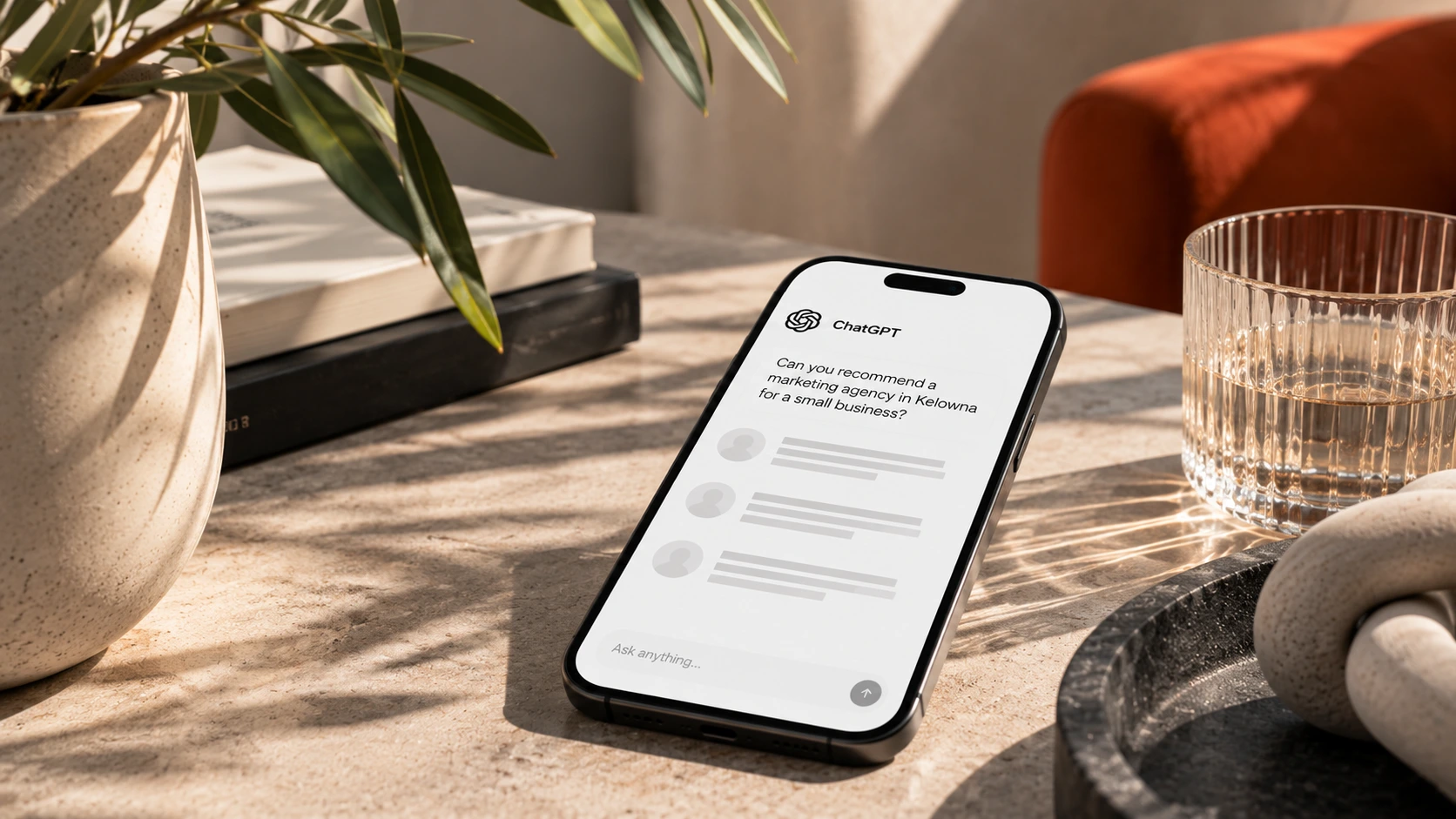
Someone asks ChatGPT to recommend a marketing agency, a dentist, an HR consultant or a local contractor. Within seconds, they have a list of businesses to consider.
Here’s the question: Is your business one of them? Business owners have spent years trying to get found on Google. Now customers can also ask AI tools to research their options, compare services and suggest businesses that fit their needs. And unlike a traditional Google search, they might not see a familiar list of ten blue links. So how do you get your business recommended by ChatGPT? Is there something special you need to add to your website? And is AI SEO actually different from regular SEO? Let’s separate what matters from the marketing noise.THE SHORT ANSWER
Yes, ChatGPT can recommend businesses when responding to relevant questions. To improve your chances of being found, make your website accessible, explain your services clearly, keep your business information accurate and build a credible presence online. There is no guaranteed formula for appearing in AI recommendations.
Does ChatGPT actually recommend local businesses?
Yes. People can use ChatGPT to research businesses, ask for recommendations and compare options. Someone might ask:- Who offers fractional HR consulting in Kelowna?
- What should I look for in a marketing agency for a small business?
- Can you recommend a dental clinic in my area?
- Which local companies offer commercial kitchen equipment repair?
Where does ChatGPT get information about businesses?
ChatGPT can answer questions using its trained knowledge and, when search is available and used, information retrieved from the web. For businesses, relevant publicly available information may include:- Your website and individual service pages
- Public business listings and directories
- Reviews and reputation information
- Articles, publications and other websites mentioning your business
- Relevant web pages that answer the customer’s specific question
THE BIG IDEA
If a customer can’t quickly understand what you do, don’t expect an AI tool to figure it out for them.
Clear information isn’t flashy. It’s useful. And useful is exactly where your strategy should start.
7 ways to improve your business’s visibility in ChatGPT and AI search
1. Make sure AI search tools can access your website
Before worrying about how your content is written, make sure search systems can actually reach it. For ChatGPT Search, OpenAI identifies a web crawler called OAI-SearchBot. Website owners can control its access through their robots.txt settings and other security tools. If your website blocks that crawler, it may limit your site’s ability to appear in ChatGPT’s search results. Google’s AI search features also depend on accessible, eligible web content. For Google AI Overviews and AI Mode, normal Google indexing requirements still matter. What to do: Check your website’s indexing settings, robots.txt file and any security tools that may block search crawlers. If you’re unsure, ask your website developer or SEO provider to review them. Don’t start changing technical settings blindly. Blocking and allowing crawlers can affect how different services use your content.2. Clearly explain what your business does
One of the simplest improvements is also one of the most overlooked. Many websites spend a lot of time explaining how passionate, innovative or customer-focused a business is without clearly describing what it sells. That makes it harder for customers to determine whether the business is relevant to their needs.TOO VAGUE
“We provide innovative solutions to help your business succeed.”
MUCH CLEARER
“We provide Google Ads management, SEO and website design for small and growing businesses in Kelowna and across Canada.”
3. Create useful pages for your individual services
Imagine someone asks ChatGPT: “Can you recommend a Kelowna company that manages Google Ads for small businesses?” A marketing agency with a detailed Google Ads service page gives search systems more relevant information to work with than one that mentions advertising only once in its footer. The same applies to dentists, accountants, contractors, consultants and almost any other service business. Each important service deserves enough information to answer the questions potential customers are likely to have. A useful service page should explain:- What the service includes
- Who it’s intended for
- What problems it helps solve
- Where the service is available
- What customers should expect
- How to take the next step
4. Answer the questions customers actually ask
This is where a good blog can help. People don’t always search with short phrases anymore. They ask detailed questions, compare options and add context. Instead of typing “HR consultant Kelowna,” someone might ask: “When should a small business hire an HR consultant instead of bringing someone on full-time?” That’s a question worth answering properly. A useful article would explain the differences, give examples of situations where each option makes sense and help the reader make a decision. What to do: Make a list of questions customers ask before hiring you. Use those questions to guide your website content. Give the direct answer early, then add the explanation, examples and important details. You don’t need to publish a blog every day. You need content worth reading.5. Keep your business information consistent and accurate
Your website says you serve Kelowna. An old directory listing says you’re in Calgary. Your Facebook page has outdated contact information. That’s not ideal for customers trying to figure out whether you’re the right business. Keep your business name, website, contact details, services and location information accurate across the platforms you maintain. For local businesses, your Google Business Profile is particularly important for Google Search and Maps. What to do: Review your website, Google Business Profile and major business listings. Correct outdated details and remove misleading information where you can. Consistency is useful, but it isn’t a magic ranking switch. Fixing one directory listing won’t suddenly guarantee a ChatGPT recommendation.6. Give people reasons to trust your business
Anyone can publish a page claiming they’re the best in town. That doesn’t make the claim particularly convincing. Instead of filling your website with generic statements, show people what makes your business credible. Depending on your industry, that could include:- Relevant qualifications and professional experience
- Detailed examples of completed work
- Genuine customer reviews and testimonials
- Helpful articles written or reviewed by knowledgeable people
- Accurate information about your services and processes
- Relevant mentions or links from credible websites
7. Keep traditional SEO on your priority list
AI search hasn’t made regular SEO irrelevant. Google explicitly says its established SEO best practices remain relevant for AI Overviews and AI Mode. That includes making content accessible, maintaining a usable website, using internal links and publishing genuinely helpful information. For ChatGPT Search, making your website accessible to the appropriate search crawler is another practical consideration. What to do: Continue improving your website’s technical health, service pages, internal links and useful content. If your existing SEO needs work, don’t abandon it because someone has started selling a shiny new AI visibility package.Is AI SEO different from traditional SEO?
There is considerable overlap. Traditional SEO focuses on improving how your website is discovered, understood and presented in search engine results. AI search visibility focuses on whether your business and content can be found, understood and surfaced in AI-powered search and recommendation experiences. Both benefit from accurate information, accessible pages, useful content and a credible online presence. The difference is partly in how people search and how results are presented. Traditional search often provides a list of websites to explore. AI tools may synthesize information into a direct answer, comparison or recommendation, sometimes linking to supporting sources. That means businesses should think beyond ranking for one keyword and consider the broader questions customers ask.WORTH REMEMBERING
Good AI visibility starts with being genuinely useful, not writing content that sounds like it was made for a robot.
Things that won’t magically get you recommended by ChatGPT
There’s no shortage of advice promising quick AI visibility wins. Some suggestions are useful. Others deserve a little scepticism.Adding “AI SEO” to every page
Repeating a phrase doesn’t make your business more relevant. Describe your services naturally and accurately.Publishing dozens of AI-generated blog posts
Volume isn’t a substitute for useful information. Generic articles that repeat what’s already online give people little reason to visit your website.Installing a special AI SEO plugin
A plugin may help manage technical settings or content, but no plugin can guarantee AI recommendations. Google’s guidance doesn’t require special AI-specific markup to appear in its AI search features.Creating an llms.txt file and calling it done
Some website owners experiment with AI-focused text files. However, Google does not require an llms.txt file for AI Overviews or AI Mode. It isn’t a replacement for crawlable, helpful website content.Checking ChatGPT once and treating it as a ranking report
AI responses can vary. One recommendation or omission isn’t enough to establish a reliable visibility trend.How can you check whether ChatGPT recommends your business?
You can start with a few realistic questions a potential customer might ask. For example, a Kelowna business owner could test:TRY THESE EXAMPLE PROMPTS
“Recommend a marketing agency in Kelowna that works with small businesses.”
“Who can help a local business improve its Google visibility?”
“Compare Kelowna agencies that offer Google Ads and SEO.”
“What should I look for when hiring a marketing agency in the Okanagan?”
A practical AI visibility checklist for small businesses
If you only have time to tackle a few things, start here.- Check website access. Make sure important pages are available to search crawlers.
- Review your homepage. Clearly state your services, audience and location.
- Improve service pages. Answer common questions about each major service.
- Update business listings. Correct outdated contact details and service information.
- Add credible information. Show genuine experience, qualifications and examples where appropriate.
- Publish helpful answers. Focus on questions customers ask before making a decision.
- Review results over time. Monitor relevant AI mentions, website enquiries and traditional search performance.
Frequently asked questions about ChatGPT and business visibility
Can ChatGPT recommend my business without me submitting it?
Yes. ChatGPT may surface information about publicly available businesses when answering relevant questions. You do not need to submit your business through a general registration form to be considered for ordinary ChatGPT Search results.Does my business need a Google Business Profile to appear in ChatGPT?
Not as a universal requirement. ChatGPT can use different information sources depending on the question and available tools. However, maintaining an accurate Google Business Profile is still important for eligible local businesses, particularly for Google Search and Maps.Does ChatGPT use my website to recommend my business?
It can. When ChatGPT uses web search, accessible website content may help inform answers and provide sources. That does not guarantee that your website will be retrieved, cited or used for a particular recommendation.Do I need schema markup for AI search?
Schema markup can help search engines understand certain kinds of structured information, but it is not a guaranteed route into AI recommendations. Google says there is no special AI-specific structured data requirement for AI Overviews or AI Mode. Any structured data you use should accurately reflect visible page content.How long does it take to appear in ChatGPT search results?
There is no guaranteed timeline. Making your website accessible and improving its content may help with discoverability, but AI search systems do not promise inclusion or a specific recommendation position.Can I pay to get my business recommended by ChatGPT?
Advertising and organic recommendations are separate. Paying for an advertisement does not guarantee that ChatGPT will recommend your business in an organic answer.Is AI SEO worth it for a small business?
It can be worth considering, particularly when customers research and compare providers using AI tools. The sensible starting point is improving your existing website, search visibility and business information before investing in expensive or unproven AI-specific tactics.The goal isn’t to impress ChatGPT. It’s to help customers find you.
AI search is changing how people research businesses, but the fundamentals haven’t disappeared. People still want to know what you do, whether you can solve their problem, whether you’re credible and how to contact you. Your website should answer those questions whether someone arrives through Google, ChatGPT, a referral or a social media post. Start there. Then build on what works.FETCH + RIPPLE MARKETING
Search is changing. Your business still needs to be found.
We help businesses in Kelowna and across Canada improve their visibility through SEO, AI search visibility, website design and digital advertising. Clear strategies, practical advice and no marketing magic tricks.
LET’S TALK MARKETING