

How old is too old for a website?
Two years? Five years? The one you built sometime before everyone started talking about AI?
Search online and you’ll find plenty of tidy answers about how often a business should redesign its website. Every two years. Every three years. Every five years. The problem is that your website doesn’t expire on a schedule. A five-year-old website that still represents the business, works beautifully on mobile, performs well in search and converts visitors can be far more useful than a shiny new website that doesn’t do any of those things. So instead of asking how old your website is, there’s a better question:Is your website still doing the job your business needs it to do?
There’s No Magic Number
Websites age differently. A simple service-business website might continue doing its job for years with regular updates. Another website can become outdated surprisingly quickly because the business changed, the technology underneath it became a problem or the way customers search and interact online moved on. That’s why we’d be suspicious of anyone telling every business it needs a new website after exactly three years. Instead, look at performance, usability, content, technology and whether the website still reflects the business you have today. If those things are working, your website’s birthday isn’t particularly interesting. If they’re not, it may be time to do something about it.
7 Signs It Might Be Time to Redesign Your Website
Forget the calendar for a minute. These are much better reasons to start thinking about a redesign.01. Your Business Has Changed. Your Website Hasn’t.
This is probably the biggest one. Businesses evolve. You add services. Drop services. Change your pricing model. Hire people. Enter new markets. Start targeting different customers. Develop a better understanding of what actually makes people choose you. Meanwhile, your website is still introducing the version of your business from four years ago. That’s a problem even if the website itself still looks perfectly fine. Your website should represent the business you’re running now — not preserve a little digital time capsule of the business you used to run.02. You Cringe a Little When Someone Asks for Your Website
You know the feeling. Someone asks for your website and you immediately start explaining it.“We’re actually updating that.”
“Ignore that page.”
“The photos are really old.”
“We’re much bigger now.”
If you need to give someone a disclaimer before sending them your URL, that’s useful information. Your website doesn’t have to be the trendiest site on the internet. But it should be something you’re comfortable putting in front of a potential customer.03. It’s Not Working Properly on a Phone
A website being technically “responsive” doesn’t necessarily mean it provides a good mobile experience. Actually use it on your phone. Are headings wrapping strangely? Are buttons tiny? Is the menu annoying? Do forms require unnecessary scrolling? Are images taking forever to load? Is important information buried halfway down the page? If using your own website on a phone is irritating, it’s probably irritating your customers too. And unlike you, they have very little reason to put up with it.04. You’re Getting Traffic but Not Enough Leads
A website doesn’t need to generate every lead your business receives. But if you’re actively sending people there through SEO, Google Ads, Meta Ads, social media or referrals, it should be helping move those visitors toward becoming customers. If people are arriving and consistently doing nothing, the website deserves a closer look. We’ve gone deeper into this in our guide to why a website gets traffic but doesn’t generate leads .05. Updating It Has Become a Project
Changing a phone number shouldn’t require three emails, a developer and a small prayer. If routine updates have become unnecessarily difficult because the website is built on outdated technology, relies on unsupported plugins or has been patched together over the years, the website itself may be getting in the way. A modern small-business website should be manageable. That doesn’t mean every business owner needs to spend Saturday night editing WordPress. It means ordinary changes shouldn’t feel dangerous.06. Search Has Changed Since You Built It
A lot has happened in search. Google still matters enormously, but people are also using AI-powered search experiences and tools to research businesses, compare options and get answers. That doesn’t mean every business needs to tear down its website because AI exists. It does mean your website needs to clearly communicate who you are, what you do, who you help, where you work and why your business is credible. Strong service pages, useful original content, clear site structure, FAQs and accurate business information all help create that context. That’s part of what we look at when working on AI search visibility and SEO .07. Your Marketing Has Outgrown the Website
This one gets overlooked. Maybe you built your website when most of your business came from referrals. Now you’re running Google Ads. You’re investing in SEO. You’re advertising on Meta. You’re publishing content. You’re sending email campaigns. You’re actually measuring conversions. But all of that marketing is sending people to a website that was never built to support it. That’s when an old website can start making new marketing less effective.A website should support where your business is going, not just where it’s been.
Old Doesn’t Automatically Mean Bad
It’s worth saying this clearly. You don’t need a new website just because yours isn’t new. There are plenty of older websites doing their jobs extremely well. If yours is fast, secure, mobile-friendly, easy to navigate, accurate, generating business and supporting your marketing, there may be no compelling reason to rebuild it. Keep maintaining it. Keep improving the content. Keep an eye on performance. Spend your marketing budget somewhere it will make a bigger difference. We’d much rather tell someone their current website is fine than sell them something they don’t actually need.Does a Website Redesign Mean Starting Over?
Not always. Sometimes the bones are good. The website might need updated copy, better service pages, stronger calls to action, new photography, improved navigation or a cleaner mobile experience. In that case, a strategic refresh may make more sense than rebuilding everything. Other times, trying to preserve an outdated website creates more work than replacing it. That can happen when the platform is limiting what you can do, the site structure no longer makes sense, the technology is outdated or the website needs substantial changes to support your current marketing. The question isn’t:“How much of this website can we save?”
It’s:“What gives us the best website from here?”
 What Should a Website Redesign Actually Improve?
If you’re going through the trouble and expense of rebuilding your website, changing the colours and making the photos bigger isn’t enough.
A redesign should solve something.
Depending on the business, that might mean:
What Should a Website Redesign Actually Improve?
If you’re going through the trouble and expense of rebuilding your website, changing the colours and making the photos bigger isn’t enough.
A redesign should solve something.
Depending on the business, that might mean:
- Making your services easier to understand
- Improving the mobile experience
- Creating clearer paths to contact, book or request a quote
- Improving site speed and technical performance
- Building a better foundation for SEO
- Giving search engines and AI systems clearer business information
- Supporting Google Ads and Meta Ads landing experiences
- Setting up meaningful analytics and conversion tracking
- Making future content easier to add
- Representing the business you actually are today
A redesign should give your business a better marketing tool — not simply a newer-looking website.
How Much Does a Website Redesign Cost?
That depends on what you’re replacing and what the new website needs to do. A straightforward five-page service website is a very different project from a large site with dozens of pages, custom functionality, booking systems, ecommerce or complex integrations. Design is only one part of the cost. Strategy, copywriting, SEO, development, mobile optimization, content migration, analytics, conversion tracking and functionality can all affect the scope. We’ve broken this down in more detail in How Much Does a Website Cost in Kelowna in 2027?Should You Redesign Before Running Google Ads?
Not automatically. But it’s worth looking at the website before you start paying to send more people to it. If the site is slow, confusing, difficult to use on mobile or doesn’t make the next step obvious, increasing traffic may simply increase the number of people experiencing those problems. Your ads and website should work together. The ad earns the click.The website has to do something with it.
Keep It, Refresh It or Redesign It?
Most websites don’t fall neatly into “good” or “bad.” Sometimes the right answer is to leave the website alone. Sometimes a few strategic improvements will buy it several more productive years. And sometimes continuing to patch the old site stops making financial sense. A useful way to think about it is: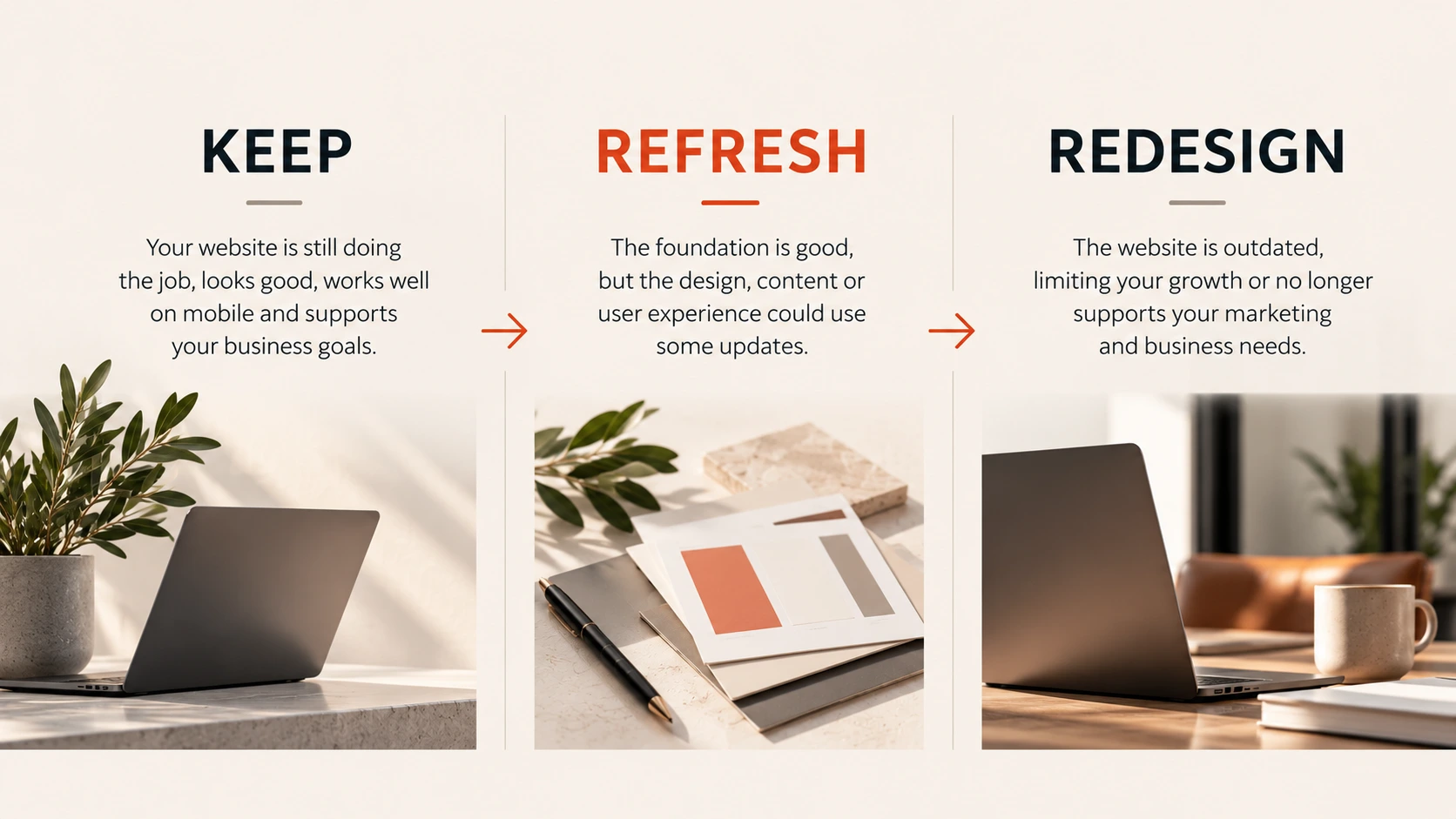
KEEP IT if the foundation is doing its job.
The website is accurate, easy to use, mobile-friendly, technically sound and supporting your marketing. Keep maintaining it and improving the content as the business evolves.REFRESH IT if the foundation is good but the experience needs work.
Update the copy, imagery, service pages, calls to action, navigation or other areas that are holding the site back without rebuilding everything.REDESIGN IT if the website itself has become the limitation.
If the platform, structure, technology, user experience or overall strategy can’t reasonably support what your business needs next, starting fresh may be the smarter investment.A Better Way to Decide If It’s Time
Instead of counting the years since your last redesign, ask these questions:If you’re answering “not really” to several of those, the website’s age may be the least interesting thing about it.
Frequently Asked Questions
How often should a small business redesign its website?
There isn’t a fixed schedule that works for every business. A website should be considered for redesign when it no longer accurately represents the business, performs poorly, creates a bad mobile experience, is difficult to maintain or no longer supports your marketing goals.Is a five-year-old website too old?
Not necessarily. Age alone isn’t a reason to replace a website. If a five-year-old site is fast, secure, mobile-friendly, accurate and still producing results, it may simply need ongoing maintenance and content updates rather than a complete redesign.Can I update my existing website instead of rebuilding it?
Often, yes. If the website has a solid technical foundation and sensible structure, improvements to the design, copy, navigation, service pages, calls to action or SEO may be enough. A rebuild makes more sense when the existing platform or structure is preventing meaningful improvements.Does redesigning a website improve SEO?
A redesign can improve SEO when it addresses issues such as poor site structure, slow performance, weak content, mobile usability or unclear service information. A redesign can also hurt existing search visibility if pages, URLs, redirects and content are handled poorly during the transition, which is why SEO should be considered before the new site launches.Should I redesign my website before investing in digital advertising?
It depends on the condition of the current website. If it clearly explains your offer, works well on mobile and makes it easy for visitors to take action, it may already be suitable for advertising. If not, fixing the website before increasing paid traffic can prevent wasted clicks and improve the overall customer journey.NOT SURE IF IT’S TIME?
You Don’t Need a New Website Just Because Yours Is Old.
You need one when the website you have is getting in the way of where your business is going. We’ll help you figure out whether that means a few smart changes or a fresh start.
LET’S TALK WEBSITES